error
Subscriptions are not available for this site while you are logged into your current account.
close
Skip to main content

Loading

The page is loading.

Please wait...


      The way companies communicate their financial performance is set to change.

      In response to calls from investors for more relevant information, IFRS 18 Presentation and Disclosure in Financial Statements(i) will enable companies to tell their story better through their financial statements. Investors will also benefit from greater consistency of presentation in the income and cash flow statements and more disaggregated information across the financial statements.

      So what does this mean for companies’ financial reporting? Essentially, companies’ net profit will not change. What will change is how they present their results on the face of the income statement and disclose information in the notes to the financial statements. This includes disclosure of certain ‘non-GAAP’ measures – management performance measures (MPMs) – which will now form part of the audited financial statements.

      IFRS 18 marks a step towards more connected reporting. Financial statements that include relevant and consistent information will afford users better information on companies’ financial performance.

      Manisha Santchurn

      Director, Accounting Advisory Services

      KPMG in the UK


      “IFRS 18 brings three categories of income and expenses, two income statement subtotals and one single note on management performance measures. These, combined with enhanced disaggregation guidance, set the stage for better and more consistent information for users – and will affect all companies.”

      Gabriela Kegalj
      KPMG global IFRS presentation leader

      IFRS 18 event - practical implementation insights


      IFRS 18 — the key new requirements

      Under current IFRS® Accounting Standards, companies use different formats to present their results, making it difficult for investors to compare financial performance across companies.

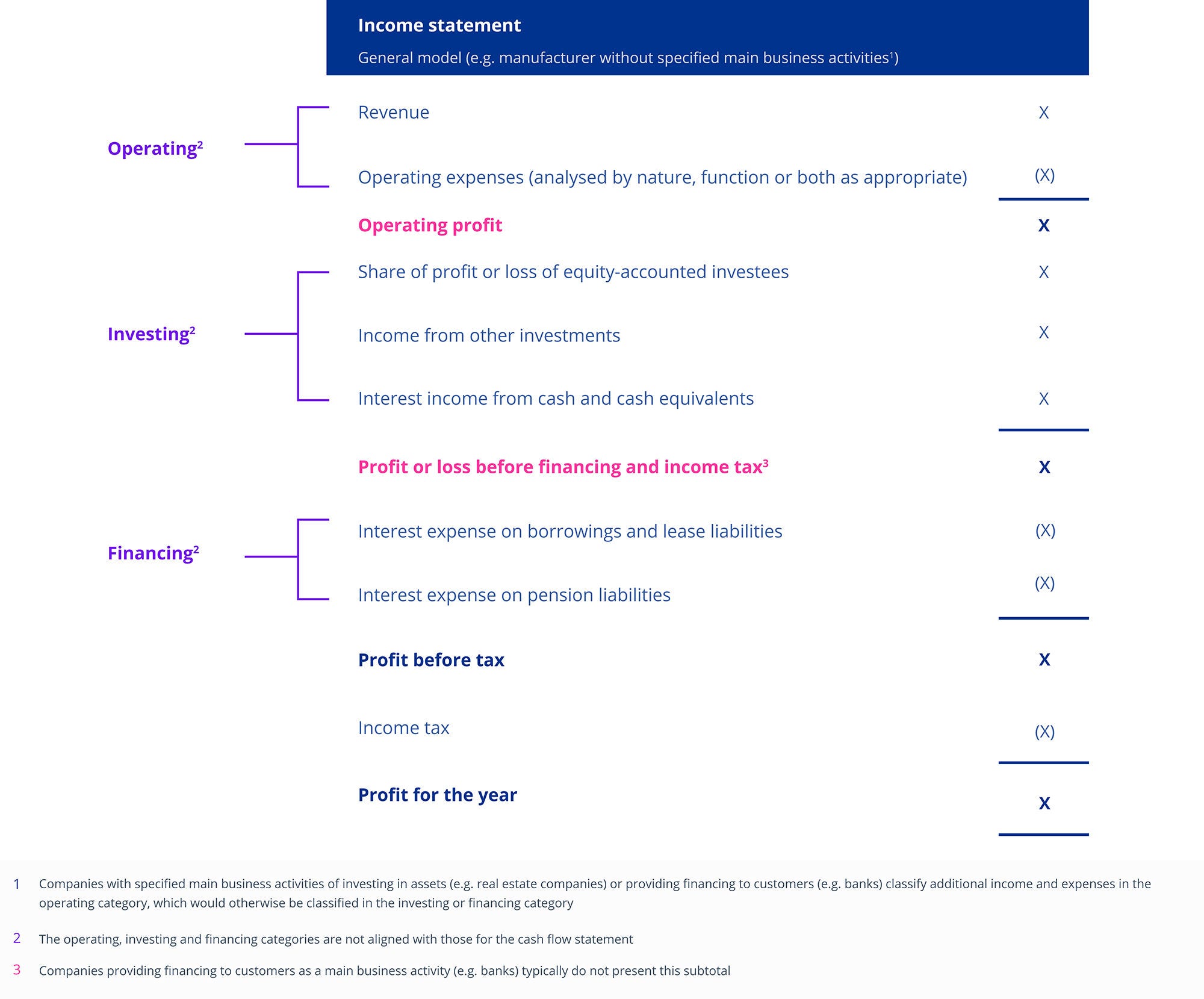
      IFRS 18 promotes a more structured income statement, as set out below. In particular, it introduces a newly defined ‘operating profit’ subtotal and a requirement for all income and expenses to be allocated between three new distinct categories based on a company’s main business activities.

      Income statement

      Companies often use ‘non-GAAP’ information to explain their financial performance because it allows them to tell their own story and provides investors with useful insight into a company’s performance.

      IFRS 18 now requires some of these ‘non-GAAP’ measures to be reported in the financial statements. It introduces a narrow definition for MPMs(ii), requiring them to be:

      • a subtotal of income and expenses;
      • used in public communications outside the financial statements; and
      • reflective of management’s view of an aspect of the financial performance of the company as a whole.

      For each MPM presented, companies will need to explain in a single note to the financial statements why the measure provides useful information, how it is calculated and reconcile it to most directly comparable common subtotal listed in IFRS 18 or total/subtotal required to be presented or disclosed by IFRS Accounting Standards.

      To provide investors with better insight into financial performance, the new standard includes enhanced guidance on how companies group information in the financial statements. This includes guidance on whether information is included in the primary financial statements or is further disaggregated in the notes.

      Companies are discouraged from labelling items as ‘other’ and will now be required to disclose more information if they continue to do so.


      How could IFRS 18 impact your business?

      IFRS 18 will not only have implications on the presentation and disclosures in the financial statements, but it may also have profound impacts on many aspects of the organisation.

      Here are some key considerations businesses may need to keep in mind as they determine the extent to which they may be impacted by IFRS 18.

      IFRS 18 may require new judgements and assessments – for example:

      • judgement in deciding the appropriate level of aggregation and disaggregation across the financial statements, including when information should be included in the primary financial statements or disaggregated in the notes based on new requirements and guidance.
      • assessing what the main business activities of the company are. For group companies with specified main business activities (SMBAs)(iii) (e.g. manufacturer that also provides financing to customers), the income statement classification at the consolidated level may differ from the operating company level, if all activities are not considered SMBAs for the group as a whole.
      • identifying the categories in which income and expenses should be classified. This assessment may be more onerous with respect to income and expenses that have specific classification requirements in IFRS 18 – for example, foreign exchange differences, fair value gains or losses from derivatives – and income and expenses which the standard does not specifically address.
      • determining which method for presenting operating expenses – by nature, by function or using a mixed presentation – provides the most useful information about operating expenses on the face of the income statement.

      Companies will need to prepare new or update disclosure within the notes to the financial statements for the analysis of operating expenses by nature (if presentation by function or mixed presentation is used in the income statement and ‘non-GAAP measures’ (if they communicate using measures that are MPMs). In addition, companies may need to further disaggregate the information disclosed in the existing notes.

      Companies will need to understand how the underlying data needed to provide or update the relevant disclosures will be sourced, and if any data collection processes and controls need to be updated to facilitate this.

      Some companies may need to adapt their financial reporting systems to track and collate the more disaggregated information to support the classification of income and expenses into the new categories.

      System implications may also arise, for example, where:

      • the output of one group company is the input for another group company and the nature of expenses is lost or not tracked at the consolidated level. This may be more significant where the standard costing method for inventories is used. This is relevant for required breakdown of function line items into the five specified nature expense.
      • there is more than one set of business activities in the group, and the classification of income and expenses will be different at the consolidated level as compared to the operating company level.
      • IFRS 18 includes specific classification requirements – for items such as foreign exchange differences, fair value gains and losses on derivatives and income and expenses from hybrid contracts. Such income and expenses may therefore need to be classified into different income statement categories. Some companies may also utilise separate treasury management systems to record information on financial instruments at a more granular level compared with the ERP systems, which may also require updates.

      Companies may need to review charts of accounts, update transaction recording systems, revise consolidation processes, add new data points for disclosures or design revised control procedures to ensure compliance.

      Currently, some companies present self-defined subtotals in the income statement, which are likely to change to align with the new defined subtotals in IFRS 18. For example, the introduction of the mandatory defined subtotal for operating profit under IFRS 18 would mean companies that currently present a subtotal labelled operating profit may need to change how they calculate the subtotal.

      Remuneration arrangements, bonus schemes or covenant tests that directly link to, or use existing self-defined subtotals such as operating profit or loss as a starting point for the relevant assessment will need to be reviewed to determine if they are impacted by IFRS 18. Depending on the specific arrangements in place, it may be necessary to amend the existing terms and conditions. Where this is the case, companies will need to determine the changes required, explain these to the relevant counterparties and, indeed, assess results and outcomes on the updated terms.

      In the UK, the annual report is a key aspect of a company’s communication with its stakeholders. It is common for the analysis in the strategic report included within the front-half of the annual report to use non-GAAP performance measures, for example adjusted operating profit or EBITDA, in assessing progress against strategic objectives and measuring business performance. IFRS 18 may cause companies to revisit the non-GAAP performance measures discussed in their front-half of annual report.

      Additionally, ensuring that investors and other stakeholders really understand how your income statement and disclosures will change ahead of the first annual report and accounts applying IFRS 18 will be critical. Involving your investor relations team early will be important so that when mandatory reporting under IFRS 18 is here, all your key stakeholders already understand the impact of the new standard and you avoid potential misinterpretations. Similarly, companies will need to educate their staff members on the requirements in IFRS 18 and changes to processes, systems and controls.


      What should you do next?

      Now is the time to get ready to report under the new standard, which is effective from 1 January 2027 and applies retrospectively. For companies with December year-ends, 2026 is already the comparative period – meaning the window to capture data in the right format is open now and recovering the required retrospectively could be challenging. In addition, companies with interim reporting, will be required to apply applicable IFRS 18 requirements in their interim financial statements in the first year of applying IFRS 18.

      Management and those charged with corporate reporting responsibilities should now be moving beyond initial awareness. A detailed and robust impact assessment is needed, covering: analysis of SMBAs, classification of income and expenses; identification of MPMs used in public communications outside the financial statements; aggregation and disaggregation of financial information and the systems and process changes required to capture comparative information from 1 January 2026 and also going forward.

      Assessing your IFRS 18 impact may not be straight forward – the devil is in the detail – we are seeing a number of application challenges, as echoed by the IFRIC interpretive discussions on IFRS 18.


      Download

      The newly issued IFRS 18 may change your future income statement and disclosures

      We explain the key new requirements and how you may be affected.
      Download

      Presentation and disclosure – IFRS 18

      Presentation and disclosure – IFRS 18

      How KPMG can help

      IFRS 18 is the most notable change to financial statement presentation in recent years. KPMG's Accounting Advisory Services team brings deep technical knowledge of the standard, practical experience of the implementation challenges companies are encountering, insight into evolving interpretations and practices and a tested, future proof, audit-ready and robust implementation approach – so you can move forward with confidence at every stage. Click below to find out more.

      • We can support you by undertaking the IFRS 18 impact assessment, reviewing the assessment prepared by management, or providing ongoing support as your assessment progresses. We can tailor our support to best meet your objectives.
      • Our approach to impact assessment involves a structured assessment of your main business activities, income statement chart of accounts, existing primary statements and notes, public communications and other reporting to identify where IFRS 18 changes what you report and how you report it.
      • We assess the classification of income and expenses across the new operating, investing and financing categories based on the determined main business activities; identify potential MPMs; consider aggregation and disaggregation requirements and cash flow statement changes, taking into account the various application challenges, including the relevant IFRIC discussions.
      • We help you assess system and process readiness, covering both comparative information and ongoing reporting. This includes data availability, chart of accounts mapping, group reporting packs, controls and wider system implications. We also consider other wider business implications e.g. impact on arrangements with KPIs affected by IFRS 18, budgeting and forecasting process, internal reporting, tax and treasury,
      • We deliver a robust impact assessment and implementation support, with a clear implementation roadmap, prioritised actions, key accounting judgements and a practical plan for producing IFRS 18-compliant financial statements. Our objective is to help make your IFRS 18 financial statements, and relevant systems and processes, robust, audit ready and future-proof where possible.
      • Review your existing income statement and disclosures (including the financial statements and front-half disclosures) in detail and identify your impacted areas.
      • Evaluate the ability of your existing systems and processes to capture the required changes to the income statement and disclosures. Identify areas where changes to those systems and processes may be necessary for compliance.
      • Determine a transition approach appropriate for your business.
      • We support you in working through the key IFRS 18 judgements and agreeing the accounting positions that will form the basis of your implementation.
      • This includes preparing accounting policy papers, designing the IFRS 18 income statement format, developing the MPM disclosure and transition notes and illustrating the changes needed across the notes to the financial statements.
      • We also help translate the impact assessment findings into practical reporting requirements, including the data points to be captured, changes to systems and charts of accounts, updates to group reporting packs, consolidation process changes and the controls needed to support comparative information and future reporting periods.
      • We support the practical delivery of change – working with your finance, treasury, systems and controls teams to implement the output from the design phase.
      • This covers updates to chart of accounts and transaction tagging, system configuration to capture IFRS 18 data at source, consolidation adjustments for group entities with different main business activities, and embedding the controls and procedures needed to capture and validate comparative-period information for transition and support ongoing IFRS 18 reporting.
      • We also support internal and external stakeholder communications, helping explain the expected changes to financial statements, KPIs and front-half reporting before the first IFRS 18 reporting period.
      • As your first IFRS 18 financial statements take shape, we prepare or review your draft interim and year end primary statements, transition note, MPM disclosure note and other impacted notes.
      • We support dry runs and testing of new system outputs, group reporting packs, processes and controls, so issues are identified and addressed before your first IFRS 18 reporting.

      Please stay tuned for more information on the new standard or get in touch with our experts below if you require support or further information.

      Our accounting and finance insights

      Something went wrong

      Oops!! Something went wrong, please try again


      MTD

      Get in touch


      Discover why organisations across the UK trust KPMG to make the difference and how we can help you to do the same.