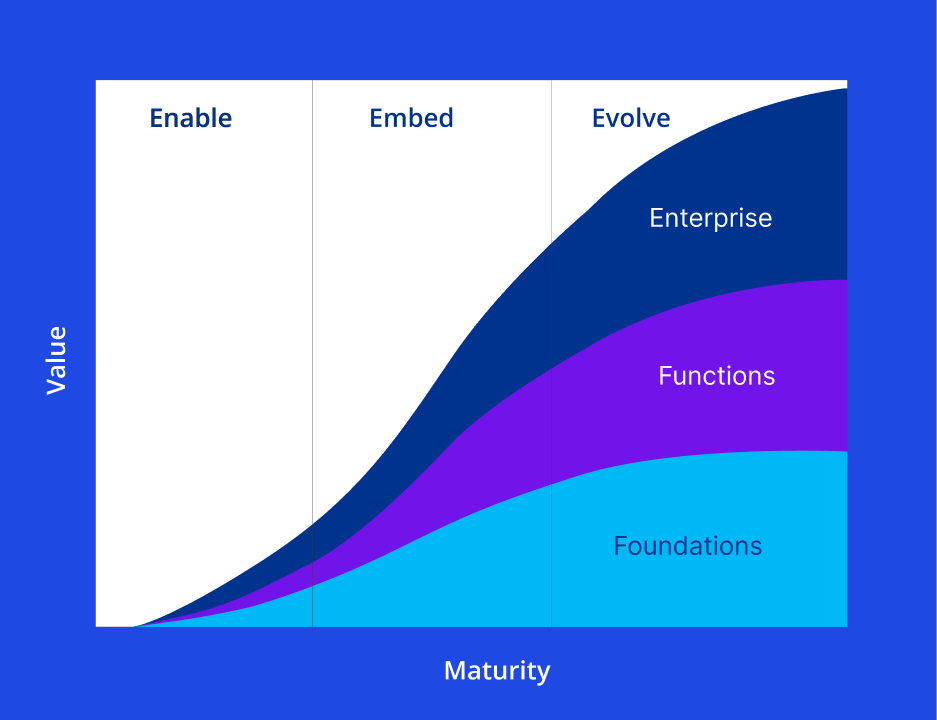
Banks have been investing in digital transformation for years: from modular IT architectures and data platforms to customer-centric processes and advanced analytics. These investments are aimed at reducing cost-to-serve and cost-to- income, accelerating “time-to-yes,” and strengthening customer interaction and risk management.
Data and AI are just one component of this broader transformation. However, in recent years the focus has shifted strongly toward AI, with high expectations around automation, improved decision-making, and scalable competitive advantage.
In practice, realizing this value proves to be complex. AI initiatives often operate in a fragmented manner, while pilots struggle to scale because they are disconnected from core processes, rely on manual steps, and face complex governance requirements. At the same time, governance structures are rapidly increasing in size and complexity. Think of additional policy frameworks, stricter model validation, extensive risk and compliance checks, and multiple approval layers. While necessary, they often slow down the implementation and scaling of AI solutions.