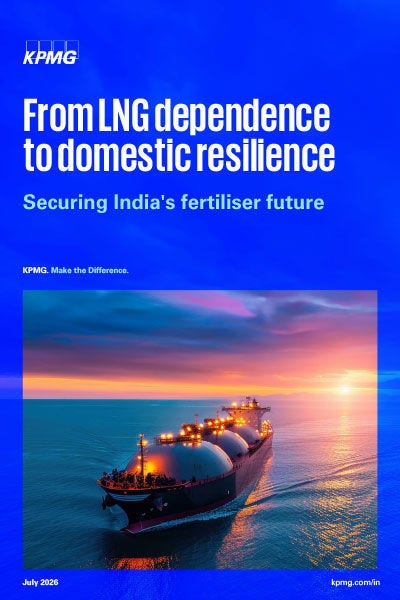
From LNG dependence to domestic resilience: Securing India's fertiliser future examines the critical link between India's energy security, fertiliser security and food security, highlighting how the country's dependence on imported liquefied natural gas (LNG) creates structural vulnerabilities across the agricultural value chain. With nearly half of India's LNG requirement met through imports - much of it sourced from the Gulf - global geopolitical disruptions, supply chain constraints and price volatility can quickly translate into higher fertiliser production costs, supply shortages and inflationary pressures.
The PoV explains how natural gas is not merely an energy source, but an essential feedstock for ammonia production, making it indispensable to the manufacture of nitrogen-based fertilisers such as urea. It analyses the transmission pathway from energy shocks to food inflation, demonstrating how disruptions in LNG supply can affect fertiliser availability, agricultural productivity and ultimately national food security. Going beyond short-term measures such as subsidies and price stabilisation, the PoV explores biogas, compressed biogas (CBG), biomethane and renewable hydrogen as domestic alternatives that can gradually reduce dependence on imported hydrocarbons while supporting a more resilient and sustainable fertiliser ecosystem. It also examines the role of the GOBARdhan initiative, circular economy approaches, organic fertilisers and integrated waste-to-energy models in strengthening domestic feedstock availability.
The PoV presents practical policy recommendations, including diversification of LNG sourcing, investment in feedstock aggregation and logistics, expansion of biogas infrastructure, integration with City Gas Distribution (CGD) networks, public-private partnerships, financing mechanisms and long-term transition pathways for renewable feedstocks. By bringing together perspectives on energy transition, fertiliser manufacturing, agriculture, climate resilience, supply chain resilience, bioenergy, green hydrogen, food inflation, sustainable agriculture, rural development and industrial policy, this PoV offers a strategic roadmap for policymakers, industry leaders and stakeholders seeking to build a more secure, self-reliant and resilient fertiliser sector. It argues that India's long-term fertiliser resilience will depend not only on managing disruptions but on fundamentally diversifying its feedstock base, strengthening domestic energy systems and creating an integrated ecosystem that supports economic growth, farmer welfare and national resilience.